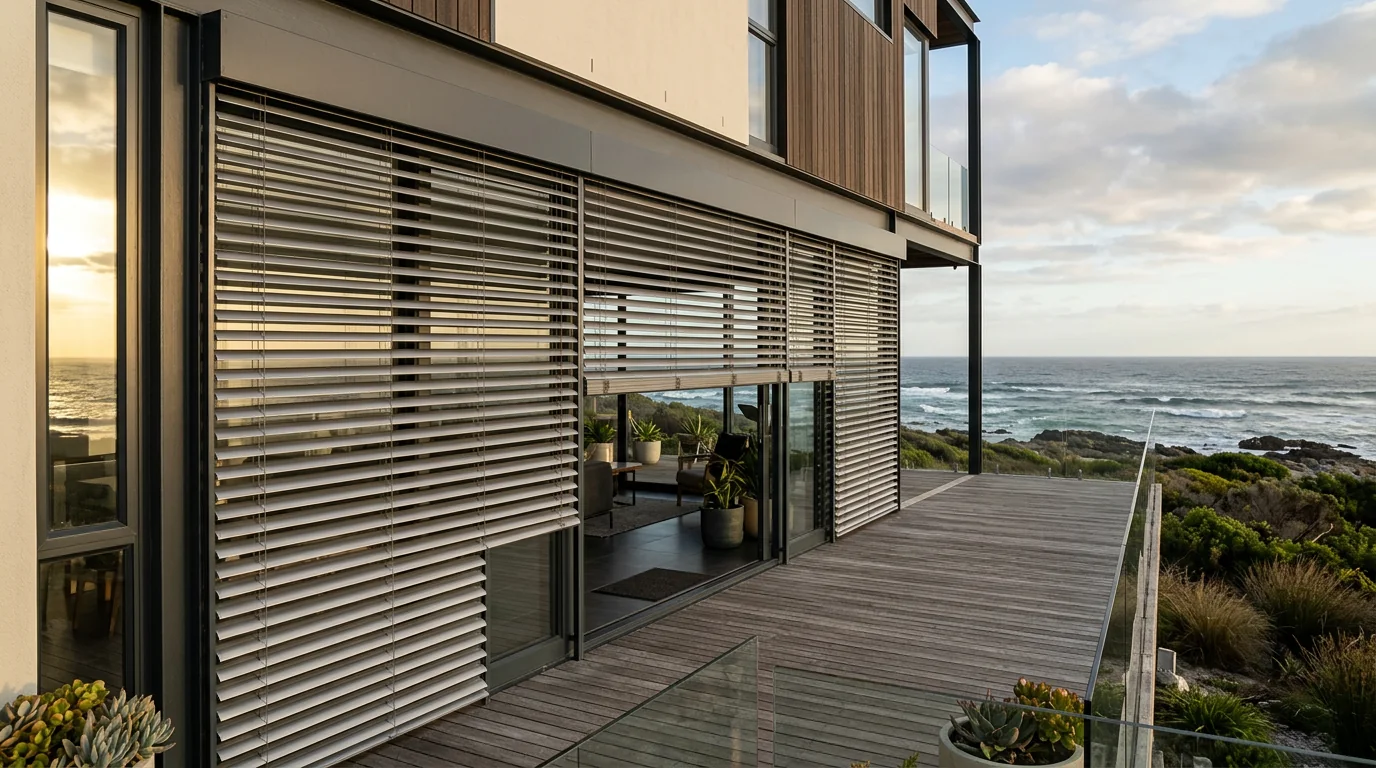
The physics, the simple version
An interior blind only ever manages heat that has already made it through the glass and into the room. External venetians intercept it before that happens. On a wide west-facing wall over open water, that difference is the whole argument for mounting the shading outside rather than in — the glass stays cooler, the room stops working as a greenhouse through the hottest part of the afternoon.
Built for a facade taking direct salt spray
Wide aluminium slats — the 60–90mm class — run in guided side rails or cables, tilting and raising like an interior venetian but engineered for weather exposure. On this coast they're effectively always motorised, with a wind sensor that auto-retracts the blind in a gust rather than leaving it to take the strain. Finishes are powder-coated to a seaside-rated spec, because standard coastal coating isn't the same as what a facade twenty metres from the water actually needs.
Where it earns its place on this stretch of coast
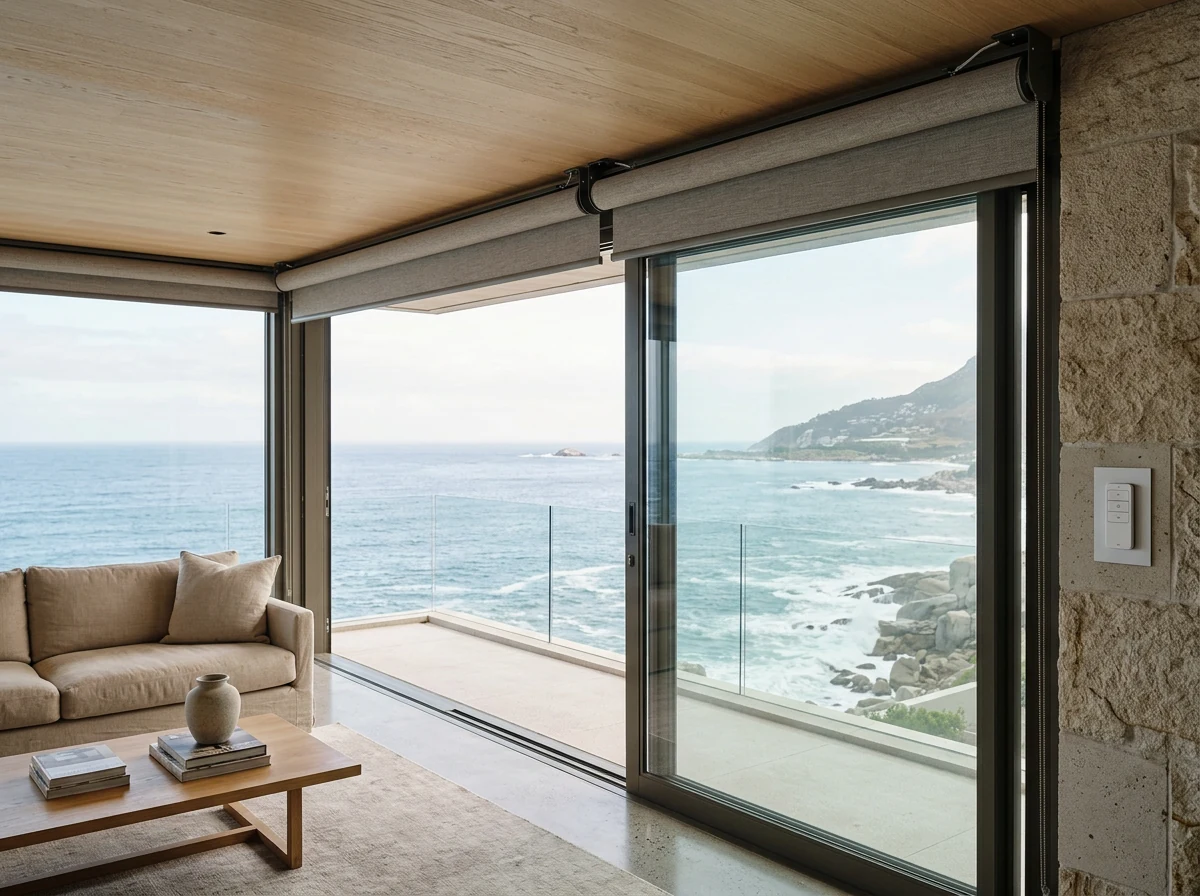
The glass villas that have replaced most of Clifton's original 1920s–30s bungalows tend to share one problem: a lot of unbroken west or south-west glazing with nothing shading it from outside. External venetians are the answer for anyone whose aircon can't keep up with that much glass through summer, or who wants the sun stopped without losing the sea view when the blind is tilted open.
Fixing points need to be planned — ideally at design stage on a new build or major renovation, though a retrofit is possible on a suitable elevation. Whose wall it is matters as much as where the sun lands: on the rebuilt glass frontages of Camps Bay the owner is usually deciding about their own facade, while on the cliff-stacked balconies of Bantry Bay anything fixed outside goes past the block's rules before it goes onto the wall. This is premium spend and a visible change to the facade, so it's worth deciding early rather than adding on afterwards. Even seaside-rated hardware wants an occasional fresh-water rinse this close to the water; we won't pretend otherwise.
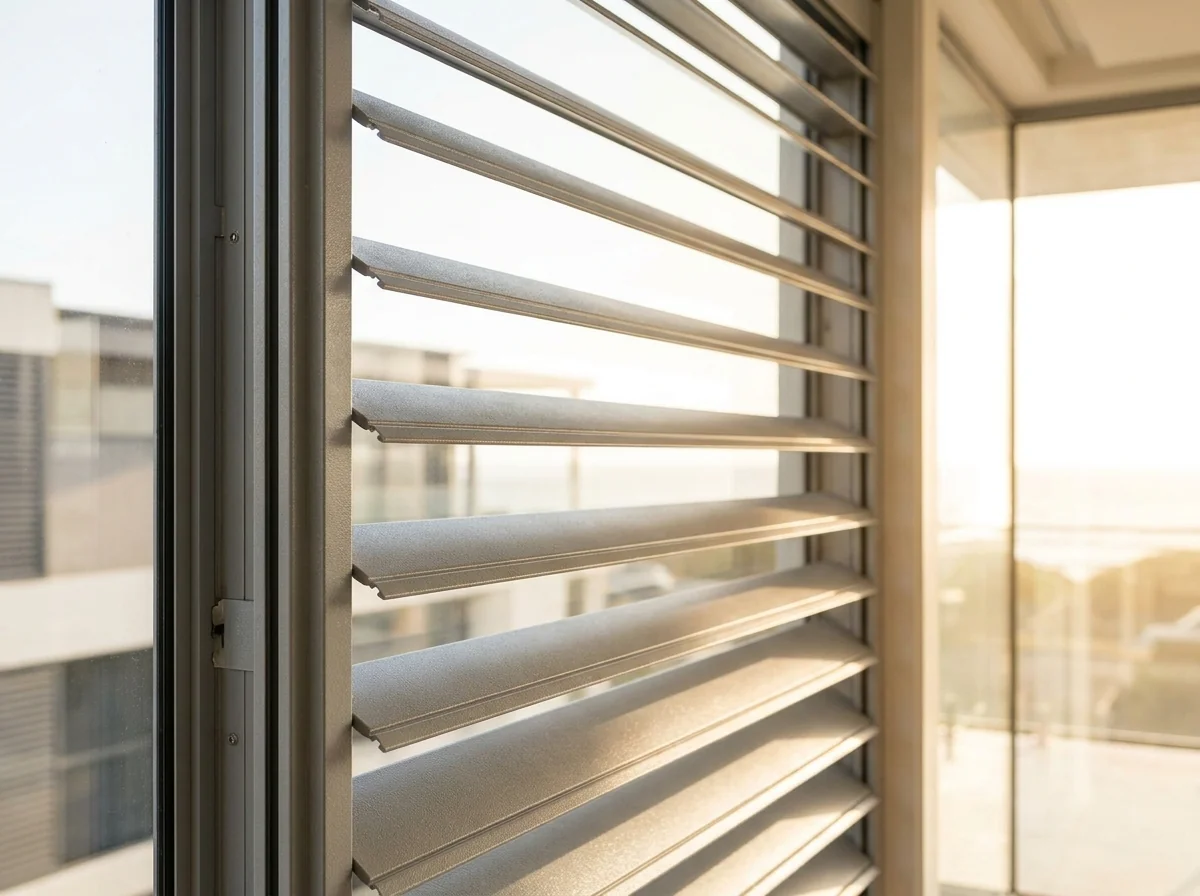
- Wide aluminium slats, 60–90mm class
- Guided side rails or cables — tilt and raise
- Motorised as standard, with wind-sensor auto-retract
- Powder-coated, seaside-rated finish
- Best planned at design stage; retrofit possible on a suitable wall
What exterior slats are worth
External venetians are engineered aluminium fixed to the face of the building, so the number is a different order to anything hanging indoors: R3,000 to R4,500 per square metre installed hand-operated, and R4,500 to R6,500 motorised. On this coast almost every set goes in motorised, because a sensor that lifts the slats before the wind gets up is most of the reason to fit them at all.
Slat width, the guide channels and what the wall is made of behind the render all move a job inside its band, and a narrow opening carries a minimum charge. Exterior work is never quoted from a photograph. The facade, the fixings and the salt exposure are all assessed during the free measure, and the written figure comes afterwards.
Got a wall of glass the sun won't leave alone?
Free in-home measure, written per-window quote, no obligation.